Contract Production: How It Works and When It Makes Sense
If you’re evaluating outside manufacturing partners, you’ve probably encountered the terms contract production and contract manufacturing dozens of times. This article breaks down what contract production actually means, how it works in practice, what drives companies to pursue it, and how the current reshoring wave is reshaping the landscape.
At Firstar, we’ve spent decades as a contract manufacturer for engineering and sourcing teams across aerospace, defense, medical devices, and industrial tooling. Whether you’re sourcing for the first time as a small business, on-shoring, or in need of additional capacity, here’s what you need to know.
What Is Contract Production?
Contract production, also called contract manufacturing, is a business arrangement in which a company outsources the physical production of components or finished goods to a specialized external manufacturer. The client retains ownership of the design, intellectual property, and customer relationship. The contract manufacturer provides the facility, equipment, skilled labor, and process know-how to execute production.
In simple terms: you design it, they build it.
Contract production arrangements vary in scope. Some clients outsource a single machined component from a broader assembly. Others hand off the entire manufacturing process to a single partner: prototyping, raw material procurement, fabrication, quality standard inspection, packaging, and delivery. The latter is what Firstar calls end-to-end manufacturing: one purchase order, one point of contact, finished quality-inspected parts on your dock when you need them.
When done right, a contract manufacturer feels like an extension of your operations.
What Does a Contract Manufacturer Look Like in Practice?
Contract manufacturers exist at every scale and across every industry. In consumer electronics, companies like Foxconn assemble devices for major original equipment manufacturers. In pharmaceuticals, contract manufacturing services produce drug compounds under strict regulatory frameworks. In precision machining — the world most relevant to engineers and sourcing professionals working with tight-tolerance metal components — a contract manufacturer is a machining facility that produces parts to customer specifications.
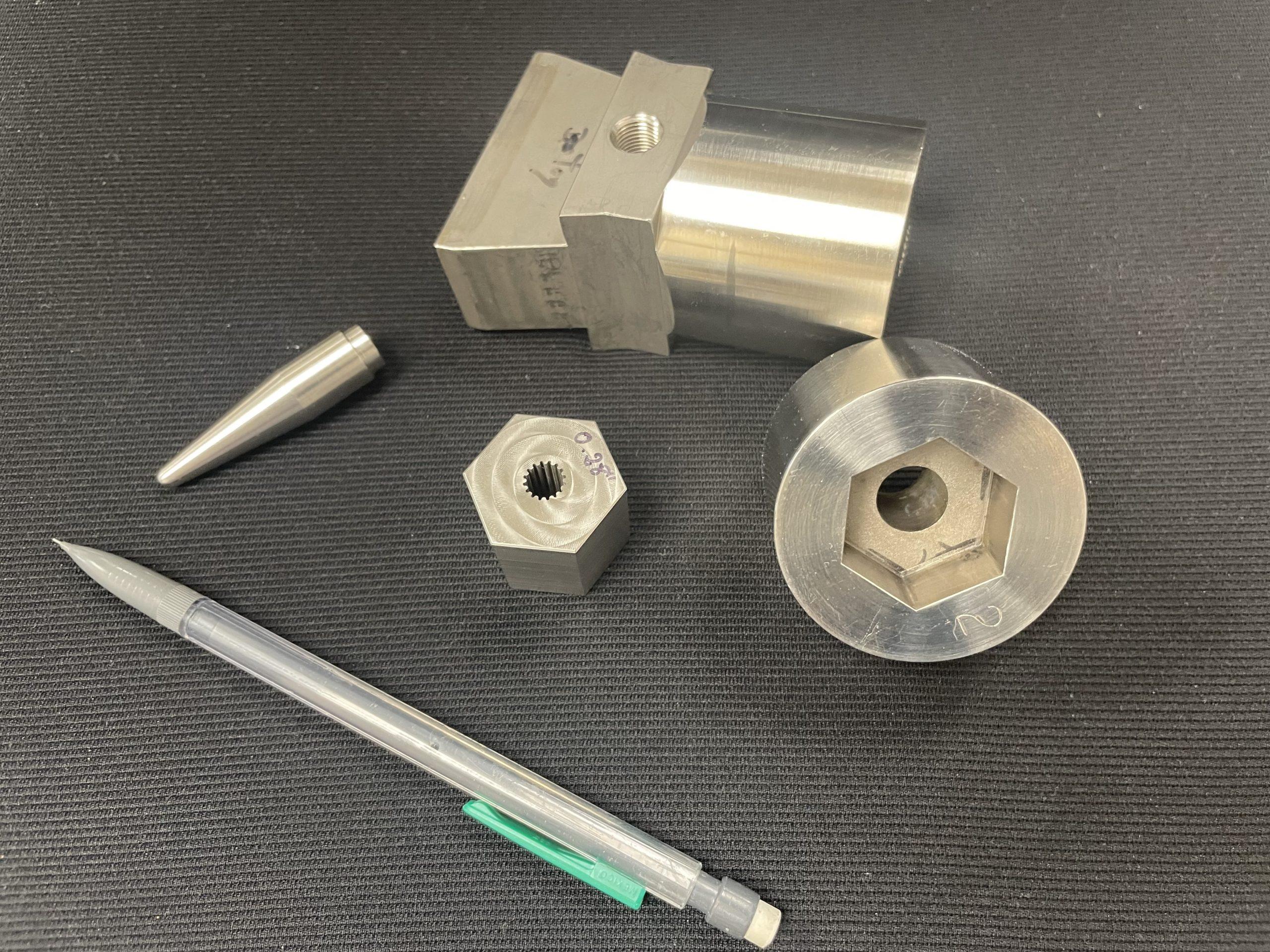
Firstar Precision is an example of a full-service precision CNC contract manufacturer. Based in Brunswick, Ohio, we produce tight-tolerance machined components, tackling the high-complexity, low- to mid-volume jobs that many shops pass on. Clients supply engineering drawings; we handle everything from raw material sourcing through final delivery, including heat treating, plating, gear cutting, and other secondary operations either in-house or through our vetted vendor network. All of this is done under one purchase order, delivering quality parts without the headache of vendor coordination.
What distinguishes a high-value contract manufacturer from a commodity job shop is engineering engagement. The best partners feel like an extension of your operations — going beyond executing prints to review designs for manufacturability, flag tolerance issues before production, and suggest modifications that improve part performance or reduce production cost. At Firstar, this Design for Manufacturability (DFM) process starts early and covers material selection, geometric complexity, toolpath optimization, custom fixturing, and part consolidation wherever it’s feasible. The goal is always a better part with cost efficiency, not just a part that meets print.
The Main Advantages of Contract Production
Contract production has become a core strategy for manufacturers of all sizes. The benefits of contract manufacturing are well established, and they show up consistently in why clients come to Firstar:
- Access to specialized equipment and expertise. Acquiring and maintaining advanced CNC equipment such as multi-axis turning centers, wire EDM, 5-axis mills, and precision grinding requires significant capital investment and a skilled workforce to operate it. At Firstar, our 27,000 sq. ft. manufacturing facility in Ohio houses multi-axis CNC turning centers, 4- and 5-axis milling, wire EDM, CNC gear shaping, OD grinding, horizontal honing, and laser marking. Clients get access to that full capability stack without carrying any of the overhead.
- Reduced capital expenditure. Outsourcing production converts fixed manufacturing costs into variable costs. Rather than carrying the overhead of a production facility year-round, clients pay for capacity when they need it. Firstar’s end-to-end model means that overhead extends to procurement, secondary processing, and delivery logistics as well.
- Faster time to market. A contract manufacturing company with the right equipment and experience can compress lead times that would take months to achieve through an internal capacity build. Firstar’s JIT fulfillment model — built around blanket orders and demand-matched delivery schedules — is specifically designed to deliver parts when demand requires them, not months ahead or weeks behind.
- Scalability. Contract manufacturers can scale up or scale down in volume more readily than in-house operations, which is particularly valuable in industries with variable demand or high-mix, low-volume production requirements. Firstar’s kanban inventory program addresses this directly: parts are stocked at our facility and released on a replenishment-triggered basis, so our clients’ production lines stay supplied without carrying excess inventory.
- Operational focus. Outsourcing production frees internal engineering and operations teams to concentrate on product development, customer relationships, and core business strategy. When Firstar is managing your project end-to-end, your team is free to focus on higher-value initiatives.
The Drawbacks — and How to Manage Them
Contract production isn’t the right answer for every situation. There are tradeoffs, and experienced sourcing professionals know to stress-test any outsourcing decision against a few key questions.
Loss of direct production control
When production moves outside your four walls, you give up direct oversight of day-to-day manufacturing decisions. Quality problems, process deviations, and capacity crunches at your supplier become your problems, even if you don’t know about them immediately. This is the most frequently cited drawback of contract manufacturing, and it’s legitimate.
The antidote is rigorous partner selection and relationship management. Firstar’s ISO 9001:2015 certification establishes documented quality processes across the full production workflow. For clients with defense programs, our Joint Certification Program (JCP) certification confirms compliance with DoD and DND data security requirements. But certifications are a floor, not a ceiling. The more important signal is whether a partner behaves like an extension of your team when something goes wrong, not just when everything is going smoothly.
Supply chain dependency and concentration risk
Relying on a single supplier for a critical component creates concentration risk. The COVID-19 pandemic and subsequent supply chain disruptions made this viscerally clear for many manufacturers. Effective mitigation involves qualifying backup suppliers for critical parts and building strategic inventory buffers for items with long lead times.
Firstar’s kanban program directly addresses inventory risk: By stocking parts at our facility against agreed replenishment signals, we decouple our clients’ production schedules from the variability of individual production runs. Clients aren’t waiting on a new order to be launched every time they need parts. The inventory is already there.
IP and confidentiality exposure
Sharing engineering drawings, specifications, and process knowledge with an outside manufacturer introduces intellectual property risk. This concern is most acute with overseas suppliers in jurisdictions with weaker IP enforcement. For clients with sensitive programs — particularly in defense and aerospace — domestic manufacturing is often a contractual or compliance requirement. Firstar is ITAR registered, and our JCP certification confirms our capability to handle controlled technical data.
Communication and coordination overhead
Managing an external manufacturing partner requires active communication investment — engineering reviews, quality audits, schedule coordination, and responsive problem-solving when issues arise. Companies that treat contract manufacturing as a transactional relationship tend to have worse outcomes than those that manage it as a true partnership.
Firstar’s end-to-end model is built to minimize that overhead on the client side. A single purchase order covers raw materials, machining, secondary operations, and delivery. Clients don’t coordinate between a material supplier, a machine shop, a heat treater, and a shipper — Firstar manages all of it and takes responsibility for the finished product.
Is Contract Manufacturing Risky?
The honest answer: It carries risk, but those risks are manageable with the right partner.
The risk profile of any contract manufacturing relationship is largely a function of three factors:
- The criticality of the part
- The qualification rigor applied to the supplier
- The ongoing management of the relationship
For tight-tolerance, safety-critical, or program-sensitive components, a more deliberate approach is warranted. That means verifying certifications, reviewing first articles rigorously, establishing documented process controls, and building relationships with supplier engineering contacts rather than just procurement contacts.
It’s also worth noting that the risks of not using contract production can be significant.
Attempting to bring specialized manufacturing capabilities in-house when the volume doesn’t justify it often results in:
- Higher per-unit costs
- Longer lead times
- Quality problems driven by insufficient process maturity
For many manufacturers, the real question isn’t whether to use contract production, it’s how to choose and manage a partner effectively.
Firstar specifically pursues the jobs that require deeper capability and process discipline. We’ve built our shop around complex, tight-tolerance, low- to mid-volume work because that’s where the value of a genuine manufacturing partner, versus a commodity supplier, is most pronounced.
How Reshoring Is Reshaping Contract Manufacturing
The past several years have seen a meaningful shift in how U.S. manufacturers think about supply chain management — and contract production is at the center of it.
The extended supply chain disruptions that began in 2020 exposed the fragility of globally distributed manufacturing networks. For companies that had offshored production to lower-cost countries, the combination of shipping delays, quality escapes, and geopolitical uncertainty produced a reckoning. “Lowest unit price” turned out to be an incomplete optimization metric when total delivered cost, lead time reliability, and supply chain resilience were factored in.
The result has been a sustained reshoring trend, accelerated by federal investment through the CHIPS Act and the IRA, and by defense-sector requirements around ITAR compliance and supply chain security. For domestic precision contract manufacturers like Firstar, reshoring is a genuine growth driver. Companies that had moved production offshore are now actively qualifying U.S. suppliers and discovering that the all-in cost differential is often narrower than expected. Factors like quality issues, tooling delays, engineering change coordination, and compliance overhead made offshore production more expensive than anticipated.
Firstar’s Ohio location positions us well for this shift. We’re within a day’s drive of a significant portion of U.S. industrial manufacturing, and our established relationships with domestic material suppliers and processing partners mean our supply chain doesn’t carry the same transatlantic risk that’s driven so many reshoring decisions. For clients evaluating domestic contract production options, we’re a direct alternative to offshore sourcing — not just for risk mitigation, but for performance on complex, tight-tolerance work.
Evaluating a Contract Manufacturer: What to Look For
When you’re selecting a contract production partner for precision machined components, the right evaluation criteria go beyond equipment lists and hourly rates. Here’s what separates a capable partner from a capable machine shop and how Firstar approaches each one:
- Certifications relevant to your program. ISO 9001 is table stakes for quality-conscious manufacturing. Defense programs may require ITAR registration or JCP/CMMC certification. Firstar is ITAR registered and holds ISO 9001:2015 and JCP certifications, as well as CMMC Level 2 (conditional, with full compliance expected in 2026). Our quality control system is built around documented process controls, not just audit compliance.
- Engineering engagement capability. Can the shop provide DFM feedback? Do they have in-house engineering staff? Firstar’s DFM process covers material selection, tolerance rationalization, toolpath optimization, and part consolidation early in the project so the final product is the best it can be.
- Material and process breadth. The right partner can machine the materials your product design requires — standard aluminum and steel, tight-tolerance stainless, or exotic alloys like Inconel, titanium, and molybdenum. Firstar has documented experience across all of these, and our vendor network covers heat treating, plating, and other secondary operations that many shops subcontract out with less control over schedule and quality assurance.
- Inventory and delivery program flexibility. For production programs with ongoing demand, the right contract manufacturer will be able to support kanban replenishment and JIT fulfillment to reduce your carrying costs and operational complexity. Firstar’s kanban program is fully integrated with our end-to-end manufacturing services: parts are stocked at our facility, replenishment is triggered automatically, and clients receive inventory exactly when their production schedule requires it.
- Track record on comparable work. Ask for case studies or references on parts of similar complexity, material, and volume profile. Firstar’s case studies document specific outcomes: an 80% lead time reduction for a client stuck with 26-week lead times and minimum order quantity constraints; custom robotic automation built for a specialty metal program running 24/7 at volume; gear cutting brought in-house to be more cost-effective when outside shops raised minimums.
Ready to Talk Through Your Production Requirements?
Firstar Precision has been manufacturing complex, tight-tolerance parts for engineering teams since 2000. Share your drawings and requirements with our team and we’ll give you an honest assessment of how we can support your program. Reach us at sales@firstarcnc.com, call 216.362.7888, or request a quote at firstarcnc.com.